Soul (Sole) Searching

October – Ordinary Time

Then – October 2002 (from an old journal entry): “I’m not going to write about shoes – exactly. However, my shoes (and I’m glad I wore a comfortable pair) walked me through an interesting weekend.”

Now – October 2022: Today, I am going to write about shoes – but not exactly. I walked out of the house, into our car my husband had already started, and checked my watch to ensure we would not be late for the 7:30 a.m. Mass. I had set my alarm for 5:30 a.m., knowing I needed to have time to wash my hair, dry it, style it, and dress a bit more deliberately than I do during the week. All the while, my mind coped with a break in our normal routine prompted by an event we had to attend after church. Other than the fact that we usually go to church at 10 a.m., something kept nagging at me – something that just didn’t feel right.

“Oh my gosh,” I gasped turning to my husband. “I forgot to take off my slippers before we left!” The anxiety dream of going to work in my slippers or in mismatched shoes had finally come true. “It’s happening…we are getting old.”

“No,” my husband noted, “YOU are getting old. I am wearing my shoes.”

Too late to turn back, I wrestled with the embarrassing thought of walking into church wearing slippers. Once we parked, my husband casually opened the trunk and handed me a pair of flip flops I stow in the car just in case I decide on an impromptu pedicure while out running a day’s worth of errands. Thank goodness. While they don’t quite fit the definition of Sunday shoes, at least these black sandals were a little less conspicuous than the bright pink pair that covered my toes.

My father is buried in sacred ground along the Stations of the Cross on our church’s property, and as we walked toward the entrance to the chapel, I felt his presence. I could hear him: “God is more interested in my soul than my soles.” I remember him saying this to my grandmother when she admonished him for his rebellious choice to wear moccasins to church one Sunday instead of his dress shoes. (My parents were young adults in the 60s. They never missed Mass, but their attire and ours, while always respectful, became a little more casual over the years. I still have photos of my sisters and me wearing chapel caps and white gloves!) 

“Thanks Dad,” I whispered to his spirit. No one noticed my feet.

Shortly after the service began, there was an awkward pause between the Penitential Act and the Glory to God. Clearing his throat, the priest looked at the guitarist and said, “Time for the Gloria….” At the same time, the musician noted to the priest, “You forgot the Kyrie…”

“See, I am not the only person lost in the fog of this morning,” I leaned over and said quietly to my husband.

The church was nearly full at this early hour, and mostly comprised of the elderly. I have a hypothesis that the older we get, the earlier we tend to get up in the morning. After all, there are only so many hours in the day…in a life! 

When it came time for the first reading, the lector, a petite elderly woman, stylishly dressed, walked deliberately to the podium at the altar. Although her voice was quite soft, she spoke with a gentle sincerity that helped me settle myself. “I am already poured out like a libation, and the time of my departure is at hand,” she read from the second book of Timothy. “I have competed well; I have finished the race; I have kept the faith.”

I glanced at my feet and had the most unholy thought of not being able to keep up with the race in these flip flops!

Once again, I glanced at my feet and had the most unholy thought of not being able to keep up with the race in these flip flops! But the cadence of the lector’s voice guided me back to the Word of God. The priest’s homily brought relevance to Luke’s Gospel, and I had to wonder if that morning I had been more like the pharisee or the tax collector. Walking toward the altar for Communion, I embraced the grace of being able to receive the Eucharist, knowing in my heart that Jesus himself would have invited me to the table whether I was wearing shoes or not. I left Mass humbled once again by my blessings and inspired to be more aware of a world where many do not have shoes, clothing, or an alarm clock that compels them to church on any given Sunday morning.

Then and Now: The journal entry I wrote twenty years earlier outlined my “walk” through a busy weekend where I not only gave a presentation of one of writing samples to colleagues in the Arizona English Teachers Association, but also traveled to Phoenix with my husband and son to see the President of the United States (George W. Bush). It had been a busy weekend. I concluded my entry with this note: “I walked through miles and emotions this past weekend. And now it is Monday. I reach for the familiar and whatever new experiences are pending this week…I reach among the shoes in my closet and select the familiar, the comfortable black shoes.” 

At least I didn’t grab my slippers by mistake!

The Author’s Chair

October – Ordinary Time

I often seek the wisdom of the “Author’s Chair” before committing my writing to publication. For years, this hand-me-down rocker was a fixture in my language arts classroom at Immaculate Heart School in Tucson. It was also one of the best teaching strategies I ever implemented. 

The Six Traits of Writing has been a popular tool over the past couple of decades for guiding students through the writing process. Part of the rubric, I would remind my young scribes, was to “publish” their work. Publishing did not mean they would all become bookstore authors, but it did mean they needed to develop the confidence to risk sharing their work…and more importantly, to offer a glimpse into their deeper selves through the words they use to express thoughts and ideas. But it takes courage to face an audience. Add to that the extra discomforting ingredient of a bad hair day or an acne breakout with the threat of getting a bad grade as you expose your personal perceptions before a fickle group of teenage peers.

Language Arts Classroom “circa” 2008

It took time and a few assignments to nurture our classroom writing community, but we did it. I would write alongside my students to prove I would never ask them to do what I could not do myself. The Author’s Chair became an important element in our success.

Of course, publishing still takes grit, whether you are a 13-year-old teenager, or a 62-year-old former writing teacher.

Today, that same Author’s Chair rests in a corner of the guest room in our home. Sometimes, I sit there with drafts of my own writing. If no one is around, I read my work aloud to test the waters of my words, catching syntax quirks and grammar foibles along the way. Only then will I click the publish button on a blog. I acknowledge my vulnerability and fight to overcome the forever qualms of “What could I possibly have to say that anyone would want to read?”

In English class, one of my students’ favorite activities was to write letters to their future grandchildren. The idea was that years and years later, perhaps a girl or boy about their age would discover their portfolio, including the letters that offered a glimpse into lives of teenagers “back in the day.” One of the required literature texts in middle school is The Diary of Anne Frank. Year after year, I was surprised and humbled by my students’ reaction to this book. Set in the thick of a war zone, young readers seem more impacted by Anne’s transition into adolescence than they are of bombs dropping on her neighborhood. We share a human response to growing up no matter what the circumstances. For this reason, I believe it is vital for students to capture moments in their lives that illustrate their story.

I strive to take the same advice. In our attic, I have a large Rubbermaid container where I have tossed too many of my old journals. Also among this collection are a few writing artifacts my mom saved from my elementary days and ones I stashed from my high school creative writing class.

I do not aspire for my journals to garner the attention of the likes of Anne Frank or a favorite author like Flannery O’Connor, but I am inspired to offer my granddaughter and her granddaughter a snapshot of what it was like to be a girl growing up during the decades of my time. I am often surprised as I read through my random reflections to discover casual remarks on world events like the Jonestown Massacre in 1978, Ronald Reagan’s election in 1980, the fall of the Berlin Wall in 1989…even a rare snowfall in Tucson during the beginning of my second semester of college. This is my story – documented in and among a myriad of poetry and snippets of news about school, travel, friends, family, marriage, childbirth, career moves, and even growing older. My grandchildren are destined for their own unique experiences amid what will be remembered as a complicated time in our country’s history. Perhaps this is why social media outlets thrive (even if journal writing may have taken a back seat). We are desperate to share with one another our human response to life as it is.

After helping to clean out my in-law’s home before it was sold, I found it heart-wrenching to have to decide what to keep and what to throw away as we sifted through boxes of photos and family treasures. Not wanting my own child to deal with this emotional tug of war is my catalyst for emptying the Rubbermaid container and compiling my journals into one or two collections that I will print, bind, and nestle among the more important shelves harboring our family records. I owe these memories to my grandchildren and their children. For this reason, I write. For this reason, I find comfort rocking toward life’s next stages in the Author’s Chair.

I Wait for Rain

October – Ordinary Time

“Each night before we go to sleep, we read a book or two, say prayers, and reluctantly close our eyes to the day. Thank God, the sun comes up in the morning and we can begin again.”

-Welcome to the World Journal, September 1993

Our son had just turned four when I wrote those words at the tail end of my journal entry. How can it be that the sun has traced its pattern across the horizon more than 10,000 times since then? My four-year-old now has a wife and two precious babies. Each night, they nestle themselves on the bed with an assortment of books, say their prayers, and set a clock that shuts it eyes when the lights go off and signals a new day when it is time to “wake up” (at an appropriate hour)! 

Thirty years after I tucked my baby into bed, I still say my evening prayers, always beginning the way my parents taught me when they tucked me in: “God bless mommy and daddy, grandma and grandpa and everyone else.” Sometimes, I add, “P.S. Please let it rain.”

I am a woman of the desert. My days usually begin with light creeping under the window shades that I leave partially raised so I don’t miss the dawn. I bask in the dusty pink-orange rays of promising light, whisper a prayer of thanksgiving for a new day, and make my way to the kitchen and espresso pot. I stubbornly admit there are mornings when I gather the covers around me and secretly harbor tempestuous thoughts, ones that defy the predictability of the golden star’s eternal creep through my windows and into my half-closed eyes. Perhaps this is my imperfect attempt to slow down the passage of time, a desire to settle into a soft comfort of cloudy gray – one that blankets me like an old fleece and allows me the freedom of deeper thoughts and memories.

I wait for rain.

I should have been a meteorologist.  In addition to being a fan of the Weather Channel, I spend too many minutes scrolling through the MyRadar phone app searching for colorful masses that predict an elusive weather pattern. I watch for a blip on the screen that could potentially snake its way up the Baja Peninsula, across the international border, and over the craggy Sierra Nevadas as highs and lows collide, gathering energy into a cloudy fist whose only outlet will be to burst open and replenish the cells of the dehydrated saguaro and my thirsty soul.

Our family lived in Yuma, Arizona for a few years during our son’s elementary days. Yuma is cradled into the southwestern corner of Arizona and often records some of the hottest temperatures in the nation. We would escape to San Diego when we craved a more moderate climate and a sandy beach adjacent to the Pacific Ocean. When we could not leave, there were afternoons we would drive through the carwash and pretend it was raining for a few minutes as the water pelted the roof of our automobile! Our subsequent move to Tucson included a pool in the backyard where, come rain or shine, the water is always there for us and for the families of mourning doves who stop by for random sips of refreshment in “their” pond.

As I write this, I am in Virginia, miles from my desert home. I spent the morning paging through old journals for a project I am compiling. (That’s where I discovered the letter to my son and the idea for this reflection!) Needing a break from my laptop, I put on my oversized University of Arizona sweatshirt to go for a walk. I glanced out toward the patio of our apartment (our home away from home during this stage of life). It was raining, the remnants of horrible hurricane Ian whipping its tailwinds up the Atlantic seaboard on its way out to sea.

So much for lofty thoughts filled with too many adjectives. I had known it might rain; I just thought it was coming later. God always answers my prayers further prompting me to take advantage of this particular weather pattern! I tied my shoes, grabbed the umbrella, and pointed myself in the direction of the Potomac River. It might be nice to see how the geese were holding up on this unusually cool and wet day.

There weren’t too many people on the trail; however, the ones who were smiled as I passed, secretly sharing their own needs to experience a day without sunshine. Only half-trying to avoid puddles, I simply put one foot in front of the other, not really thinking of anything. That, in and of itself, proved therapeutic.

All morning, I had been pondering the passage of time (and several of the old journal entries I had decided to toss in the trashcan.) Walking, I slowly let those thoughts go. I subconsciously began to focus on my immediate landscape – leaves succumbing to autumn, fat acorns that crunched as I stepped on them, dots of vibrant color in the defiant blooms of summer’s final flowers, a turtle perched on the one rock not submerged by a rising tide. And the ducks and geese – quite impervious as they glided along the shoreline.

I silently conversed with God as I continued, experiencing peace punctuated by a darker thought as I selfishly drank in the aftermath of this hurricane, knowing how others continue to suffer the eye of that storm. I allowed myself to be a conduit of both the light and the dark.

The breeze shifted and the temperature dropped a degree or two as I turned up one of Old Town Alexandria’s cobbled streets and headed home. It was still drizzling and there was not even a tiny sliver of an opening in the dense clouds.

I wait for sunshine.

Home again and at my keyboard, I reconcile myself with the grace of this day – one that I know I will have to reluctantly close my eyes to later this evening. “Thank God, the sun comes up each morning and we can begin again.”  

Chasing Metaphors

September – Ordinary Time

Today, the metaphors were pooled at my feet in a pile of unraveled yarn. I had knitted and purled this variegated project too many times – a scarf with a lace inset, no…a hat with a cable…better yet, the front panel of a sweater. All went well until I twisted a stitch, dropped a stitch, forgot a stitch. So much for trying to find a pattern to match the skein of yarn I found on sale a few weeks ago at Michaels!

I frogged the frazzled wool (for the third time) back to the cast on row. I had just spent 15 minutes that turned into two hours accomplishing absolutely nothing. Frustrated, I gathered the tangled jumble, walked to my bedroom, and stashed the entire mess into a dark corner of the closet. Mustering a surge of guilty energy, I then managed to wash the breakfast dishes, take a shower, write an email, and scrabble through the bills in record time. I was driven solely by a compulsion to have something concrete to report later when my husband and I would share details of our day over dinner (which I had not planned yet).

It’s been almost three years since I took my name off the door of the Principal’s office at St. Augustine Catholic High School in Tucson, Arizona to follow my husband’s job to Washington, D.C. As much as I have tried to define my purpose as we hopscotch between the east coast and our “real” home in Arizona, I find my unemployed retired self often feeling just as tangled as the knots now hidden in my closet.

I am untitled.

And although my epitaph will someday include daughter, wife, mother, grandma, journalist, teacher, and principal, those titles have become somewhat honorary if I am being honest. Today, my signature block simply reads “Lynn.”

After my morning of discontent, I laced my tennis shoes and headed out for a long walk from our apartment through the ever-quaint streets of Old Town Alexandria. I ultimately ended up seated at a favorite bench looking out over the Potomac River. Inserting my earbuds, I tuned into Day 269 of Father Mike Schmitz’s Bible in a Year Podcast. (I am proud of myself to committing to this endeavor!)

“For whoever has despised a day of small things shall rejoice” (Zechariah 4:10). Is it ironic or coincidental that this particular quotation trickled into my ears today?

While I am no longer tasked with doing what I consider great things like educating children and running a school, what do I really have to complain about? I berate myself for feeling selfish. Haven’t I always said, “When I retire, I will have time to read, to write, to travel, to volunteer, to study, to take afternoon walks, to knit?” (Actually, I never aspired to knit.)

When I truly reflect on it, I haven’t completely wasted my time over the past few years. I taught English to middle schoolers online during the pandemic. I work now and then training teachers in curriculum development. I have traveled to Italy with my sisters. I have time to explore the historical sights of our country’s Capital City. I am able to spend quality time in Arizona with our grand babies and also in Pennsylvania with my husband’s family. I completed a class on Jane Austen. I am going to the Holy Land with my mother early next year. I have even knitted a couple of blankets to donate to the Christ Child Society – an organization I hope to volunteer with when we finally settle back in Arizona again.

More importantly, I am re-discovering the joy of spending quality time with my husband. Nearly 40 years ago, we began our marriage in a two-bedroom apartment, and now, we share a two-bedroom apartment while living in D.C. (The first was HUD-subsidized; this one is not!) I have time to plan and cook healthy meals. It is enjoyable to market shop – three blocks to the to fish store to buy fresh scallops, just down the street to the Thursday afternoon farmers market for in-season produce. Sometimes, I take the metro and meet Joe in Georgetown for dinner at one of our new favorite restaurants. We have reconnected with colleagues from our college and Air Force days who have settled in the area. On Sundays, we go to Holy Rosary Church downtown where Mass is said in Italian. After church, we enjoy an espresso in the parish hall with new friends who have become like family over the past three years.

Despite this complicated world and all the conflicts that tend to tie me in knots both externally and internally, I realize what I already know – there are treasures to be found in the “small things.” After all, every beautiful tapestry is a collection of single stitches. It is within the patterns of small things that I am slowly discerning that it is less important to be titled and more important to focus on what is Still (Extra) Ordinary Time.

Full disclosure: On my way to the bench along the Potomac, I walked through Old Town and to my favorite knitting store. Pattern in hand (not the other way around), I purchased the yarn I would need for my next project. When I got home, I went straight to my closet, pulled out the mess I had stashed there earlier and threw it in the trash can.

Sometimes, you have to take charge of those tangled metaphors and put them where they belong.

No Excuses

Finding Restfulness in the Midst of Restlessness

Holy Week – April

It took a $38.20 charge to my PayPal account to jolt me out of my isolated lethargy of the past several weeks. I assumed WordPress would charge me for next year’s subscription close to the date it would renew, not the month before. Alas, I am in no mood to fight. 

“Perhaps,” my lazy gadfly whispers, “this might be a sign for you to whack through the weeds of your creative intentions, face your pandemic of doubt, and channel your blighted energy into your unmanicured fingertips where they meet the keyboard.”

“Yeah, whatever,” I mumble (nowadays, talking to oneself is survival, not a sign of dementia). “I’m back to my blog because I hate wasting money!”

I have no excuse. I have recently discovered that 24 hours is plenty of time in a day. For years, I have been able to safely dream outside my cone of reality knowing that I would probably “never have time” to do those things I always said I would do “if I had the time.” There were always good reasons for my procrastination like raising a child, building a career, planting flowers in the spring, and pulling weeds in the summer. It’s so much easier to plan than to do.

But here I am.

I was just getting used to semi-retirement and a recent move to the eastern seaboard when the Coronavirus seeped into every area of our world’s semblance of order. I had spent the past few months searching and exploring everything from restaurants, coffee bars, and nail salons to museums and national monuments. Where I had been able to stay busy with the mechanics of settling into a new environment, I, like so many of us, now have hours and hours to fill as I experiment with the new vocabulary of isolation and social distancing. What an opportunity, right?

I will give myself some credit. I am dabbling with – not necessarily embracing – the loftier goals of my “when I have time” ventures. I signed up for an online class focused on spirituality and prayer. I bought a new journal. I ordered a few books written by authors who kept journals. I logged into a yoga channel on YouTube. I bought six skeins of yarn. I started two writing projects. I began to track my daily Weight Watchers points.

So far, I have had some success. I follow a pretty regular morning yoga ritual. I prepare healthy meals for my husband and me. And, my obsession with knitting has inspired shock and awe among my family. My mother’s unsuccessful attempts to seed my crafting abilities took more than 40 years to germinate…but now, I am out of control. To date (since October), I have knitted three scarves, a baby blanket, six hats, three potholders, and am currently more than 60 rows into an afghan!

I am challenging myself to write, but I must admit that I suffer nagging and existential doubts that test the waters of evolving authorship. On positive days, I tell myself it doesn’t matter if anyone ever wants to read my stories; on negative days, I stop writing. 

I am exploring my religion. I have always tried to honor Church with sincerity and devotion. As I enter this stage of my older life, I find myself searching for ways that lead me beyond the rituals of my faith – which I deeply revere – and into a more contemplative place where my rational self doesn’t always have to get in the way. When I signed up for the online class on centering prayer, my intentions were well positioned, but I admit that I was probably looking for a template that would give me all the tools, provide the instruction, and then quiz me on my success. Obviously, it doesn’t work that way. As I diligently persisted through the modules facilitated by the late Father Thomas Keating, I also read one of the books that has been on my someday list for years – Thomas Merton’s Seven Storey Mountain. I was inspired by Merton’s journey but naively caught myself wondering how anyone other than a Trappist monk could ever have the time and space to live such a full life, study the great religious doctors, and then ultimately find a certain freedom in literally letting much of it go. For me, when I try to sit for even 20 minutes and focus on not focusing, I begin to itch – literally and figuratively.  Perhaps that is what the centering prayer is all about – discovering those things in our lives that make us “itch” and then turning those irritants over to God. I’m trying.

Another book I am reading is called The Naked Now by Franciscan friar and contemporary author, Richard Rohr. If I am interpreting correctly, the ability to truly wake up spiritually is to let go of pre-conceived notions of how we view the world. There doesn’t always have to be a right way or a wrong way in prayer or politics or all those other big ideas that bog us down (what Rohr calls dualistic thinking). I mean really, if this virus is teaching us anything, it is to let go of almost everything except the common relational bond we have with each other to simply survive.

“Contemplation,” Rohr writes, “is an exercise in keeping your heart and mind spaces open long enough for the mind to see the other hidden material.” This makes sense to me. Right now, I believe I am discovering a purpose in the exercise…much like I do in working through a mindful pose in yoga, losing hours in the creative practice of writing, or mindlessly stitching the patterns of a knitting project. In the process, I am unearthing some of the hidden material in my life and starting to feel a little more restful even in the midst of my restlessness.

I also feel justified in accidentally marking the auto-renewal box of my WordPress subscription.  Here’s to more than a penny for my thoughts – $38.20 to be exact!  

One Letter at a Time

(The Thesis is in the Final Paragraph)

Advent – December

My piano is a laptop where I compose the music of my muses one letter at a time. Forever pleased that I paid attention during high school typing classes, I impress even myself that my fingers move almost as quickly as my thoughts. My mind seeks creativity among dense clouds and a gray sky. I view the landscape asymmetrically from my second- floor writing space where the window before me draws my eyes to trees stripped of their leaves, bare branches opening to a wider street where cars move persistently north and south. My hands linger above home row, seeking just the right words to capture autumn emotions on this cusp of winter. Just last year, I wrote from the Principal’s Office – newsletters filled with anecdotes of school.  Now, thousands of miles away, I take tentative steps in old shoes out of the comfortable breezeways of my career and walk cobbled streets of this colonial city that bears the burden of tangled politics and ever-evolving history.

These mornings, I have time to pour a second cup of coffee instead of rushing to work on time to unlock the front door. I am becoming accustomed to watching the Today Show and the beginning of Kelly and Ryanbefore moving to my desk and online tasks. Lately, my new routine has been interrupted by “breaking news.” I actually called my sister the other day and remarked that I must really be embracing retirement. After all, since when would I become annoyed that I missed the trivia question on my television show because the Speaker of the House had an important announcement? 

Of course, I always listen to the news. It’s in my DNA.

Years ago, during my first career as a journalist, I would have perched at the edge of my seat to hear a news update. Today, I switch between channels to analyze broadcasts interpreted to nurture the insistent opinions of those who share their diverse perceptions of the same reality. No one is right; no one is wrong.

I am not writing about politics – especially from this dynamic city that is now my temporary home. I love Washington, D.C. As a child living on the east coast many years ago, some of my best memories are born from visits to our nation’s capitol. Earlier this month, my husband and I went to Mass at the Shrine of the Immaculate Conception – a beautiful basilica where my prayers subconsciously turned to daydreams and meandered to cherished memories of my young sisters and I nestled together with our parents on the polished pews. I thought back over the years and could still envision us in our Sears Roebuck dresses and saddle shoes. We wore lacy chapel caps on the crowns of our cropped haircuts. (We called them doilies and couldn’t wait to take them off after church!) My past and present selves sought to identify the saints in niches far above – a marbled reminder of something that is somehow static and dynamic all at the same time. No matter how much I have traveled, a part of me was raised in this city.

The liturgical year has ended just as fall is turning to winter. And just like that, we have lit the third candle on our Advent wreaths. The sun-starved days of this season lead us not only toward Christmas, but also the beginning of a new calendar year. I read somewhere that even as we grow older, the vision we have of ourselves doesn’t really age. So even though my physical body might be measured by nearly six decades, I still “feel” the way I did when I was six years old kneeling rather uncomfortably on the kneelers in the Basilica. Then, it was hard to see over the pew in front of me; now, my joints are grateful when it’s time to stand. However, I am still me and the faith born in my youth continues its journey in a timeless, ageless sort of way. I am reminded of this Bible verse: “But do not ignore this one fact, beloved, that with the Lord one day is like a thousand years and a thousand years like one day” (2 Peter 3:8).

Defying all conventions of writing, my thesis is finally being revealed to me in this last paragraph of this composition. Such are those muses on an overcast day! Three years ago this month our father passed away. I pause at the end of this quiet reflection, comforted in knowing that today’s written song is dedicated to my mother, my sisters and all of our children. Wherever we are in our lives at this moment is exactly where we are supposed to be. There is an angel watching over us, casting true rays of God’s light through the grayest clouds, into the window, and onto the keyboard where I type…one letter at a time.

Reading Into Retirement

October – Ordinary Time

I set my cell phone alarm for 30 minutes. I certainly have the luxury to sit and read for a half hour, right? I shift into a comfy position on the couch in our family room and swipe open my Kindle. When the alarm sounds, I am so immersed in the latest conflict my characters face that I rationalize another 30 minutes. I move outside to the patio to enjoy the fall afternoon. The alarm goes off again, and I look up to notice the late afternoon sun is giving way to a pending dusk. Dinner is simmering on the stove, laundry is in the dryer, and Joe won’t be home for at least another hour.  I make a conscious choice. I toss the phone aside and finish the novel.

It’s been about a month since Joe and I both came home to Tucson for our grandchild’s baptism. My husband went back to D.C. after the celebration with plans to return three weeks later for a business trip.  I opted to stay in Tucson for some extra grandbaby snuggles and to accomplish a few home maintenance projects. It’s been a nice break. 

However, now that my husband is here again, it dawned on us that for the first time in years, we would have only one car to share this week (the other is in Washington). Since his schedule requires transportation, I have been exiled to three acres and four bedrooms!

In the 18 years we have owned our house, I believe this is the first time I have spent four consecutive days at home. A car in Washington, D.C. is rarely an issue because of the proximity of grocery stores and metro stations. However, it is a two-mile walk along a busy road to even get to a Circle K from my Tucson neighborhood. Looking back, the only times I ever spent a full day at home were a rare sick day when our son was younger, perhaps a holiday when the family came for dinner, and maybe a day or so when we chose to “vacation” at home and enjoy our swimming pool and built-in barbecue.

My self-imposed exile is hardly a sacrifice, but all this unstructured time is forcing me to reconcile the reality of my situation. Without a full-time career all of a sudden, my Google calendar has ceased its endless chirping reminders. I even check periodically to make sure I haven’t set my technological notifications to silent. As selfish as it may sound, I have discovered that instead of feeling liberated by my new-found freedom, I am burdened by the weight of “when I have time…”

When I have time, I will exercise every day. When I have time, I will write a novel. When I have time, I will volunteer. When I have time, I will focus on my prayer life. When I have time, I will organize all our family photos into albums. But…now that I have time, I feel disoriented. 

Then: My body is used to getting up early and showering and fixing my hair and rushing off to work to perhaps stopping for a coffee and then eating lunch at my desk in between teaching and meeting parents and students to finally shutting down my computer while planning dinner on the fly before doing the bills and one load of laundry in between cooking and straightening the house to watching an hour of television to going to bed to beginning again. 

My days used to be one long sentence. Today, I have re-discovered punctuation.

Now: There are still groceries to purchase and bills to pay, but there are commas between those things I have to do and what I want to do.  This leaves space to read, to write, to re-establish relationships with friends, to exercise (maybe) and to dig into the stockpile of plans and dreams I have put aside for years. When I write, I recall grammar rules before selecting a comma or a semi-colon. I have to decide where to end a paragraph and begin a new one. Now, as I begin to “write” a new normal, I have to stop and think about ways to define the grammatical pauses in my day. For instance, my prayer life feels un-focused. My ability to sit still and read seems like a guilty pleasure. I can’t quite decide what to wear in the morning. It’s difficult to know where I fit in to a new part-time position while recognizing that those who filled my full-time position are doing a great job without me. I must learn patience with myself. I need to allow myself time to train these thoughts, and then grant myself the grace to proofread and edit along the way.

(Along with punctuation, I have also re-discovered my love of metaphors and a passion for parenthetical thoughts!)

I will have the car again tomorrow, and both Joe and I will finalize the pending details for our return to the east coast. These past few days have truly been a gift, a glimpse at opportunity knocking. I have relished getting up early each morning not for work, but to walk with neighbors up and down the hills of our desert reserve. I have read every section of the paper, had two cups of coffee before my shower…and even watched a couple of the a.m. news shows – into their second hours! While I have not battled the photo albums or the attic, I have done what I need to do each day and am learning that I don’t have to set my alarm if I want to read. Just this morning, I uploaded more books to my Kindle library. The titles mimic my mood. I am already through the first chapter of Paulo Coelho’s Hippie, which hearkens back to the 70s when I was only ten years old and very impressionable when it came to the hippies we used to emulate in our denim bell bottoms, crudely doodled peace signs, and plastic smiley face jewelry. I also downloaded The Love Letters by Madeleine L’Engle. I think it is the only book of hers I have not read. (I just counted 16 of her works on a shelf in my bookcase!) And then, there is a series that starts with Living Apart Together by Elise Darcy. The main character is woman in her 60s (I am thinking this is chick lit for the every-evolving middle-aged woman!).

I have time. And at this moment, my stomach is leading me to the refrigerator where I will make lunch out of last night’s leftovers. Later, I will post this blog (see, I am writing!), and then I should probably fold the towels that are still warm from a tumble in the dryer. After that…I might just spend the rest of the afternoon reading.

Writing into Retirement

Ordinary Time – October

Lightning struck, the power went out, and with that, more than 1,200 words I had written about problems at a local nursing home evaporated into what was then a cloudless cyberspace. I reacted not as a tough journalist of the 80s, but rather the cub reporter I was. I cried. 

And then, I re-wrote my story.

I was reminded of this today – nearly 40 years later – when I went to open a document on my hard drive and discovered that in my recent zeal to “Clean My Mac,” I deleted what was supposed to have been my inaugural foray into writing into retirement.

It’s been a couple of months since I turned in my keys to St. Augustine Catholic High School and threw away my business cards. Since then, my husband has begun a challenging new position in Washington, D.C. We have set up our East Coast apartment while maintaining our home in the Southwest, have welcomed a beautiful grandchild into our lives, and have begun racking up airline miles as we traverse not only the country, but also begin taking tentative steps on an uncharted path in our lives.

My journal – host to thousands of rambling words focused on thoughts and emotions better written than said – has been quite abandoned over the past weeks as I have worked diligently to impose a structure on the business of our lives. Now that this system is mostly in place, I am compelled once again not only to journal, but also to ponder, to put into coherent words the moments that ground me and that help me appreciate the small moments within the larger hours of life.

The story I lost was good. It was about a recent Sunday when my husband and I missed Mass because of having to catch a train from a family visit in Philadelphia back to Washington. During that trip, we experienced the blessing of a kind Amtrak ticket taker, an amazing discussion with a 76-year-old passenger, and finally a holy moment with the woman who drove us in her Uber back to our apartment. I wrote quite cleverly that even though we had not gone to Mass, I felt like we had been to Church.

Perhaps that is my story to cherish and one I don’t need to re-write – at least today. I feel a touch bereft for my lost words, but I did not cry.

In some ways, I have isolated my feelings about these months of transition. I bristle when someone mentions that I am “retired” because I really don’t know if I am or not. It is true that I am no longer a high school principal, but I do have a couple of part-time gigs that keep me attached to education. I am also being quite intentional about taking time out of my day to walk, to explore, to read, and to drink coffee. I can’t quite get over not being attached 24/7 to my school’s network, but I do enjoy planning a dinner menu, shopping the markets, and actually having the time to cook. My husband and I are also trying to do what we said we would do “if” the move to D.C. materialized. Recently, we shopped at the fish market at the District Harbor. Talk about memories of childhood days on the Eastern Shore – blue crabs. Need I say more? We have visited museums and sights including Ford’s Theater and the National Archives. We have re-connected with dear friends. For once, at least for me, I am discovering that there is just enough time in every day.

I recently read a poem in which the author recounts a message from a speaker who notes that most of us move through our lives as if in “a daydream.” We are cognizant of the big picture but can’t seem to focus on the little details. How true. Up to now, I would probably say I have been aware of my propensity to see the umbrella, but not necessarily everything underneath it. However, if this transition from non-stop career climbing to semi-retirement is leading me anywhere, it is guiding me back to the details that allow life to be joyful instead of scary. When I was a child, I would lay on the grass and look for shapes in the clouds. Today, I worry if I lay in the grass, how many bug bites will I get? When I was a child, we planted seeds and watched them grow. Today, I look for plants in full bloom to decorate my patio. I used to play marbles and catch fireflies…and although I might not do that anymore, I feel drawn to the details again – the Amtrak ticket taker, the first smiles from our grandchild, a visit with my Mom, re-creating some of the recipes I first made for my husband when we got married 36 years ago.

When I cleaned out my office before leaving St. Augustine, I discovered a jar of marbles my first best friend in the world had sent me a few years earlier. (Ask anyone – even if I don’t play marbles anymore, I still keep a few with me just in case!) Along with her gift was this note: “Saw these and thought of you. They’re sort of like our treasured ‘moonies’ but with some iridescence…” I can’t help thinking that this is a great metaphor for me and for those of us seeking meaning as we navigate life’s stages. We are burnished, iridescent treasures willing to risk our very being and emotions for opportunities that will indeed include lost words, but will always lead to new stories.

Playing School

Ordinary Time – August/September

Stuffed animals and little sisters are amazing students when you are six years old and completely engaged in an imaginary world where the laundry room becomes a class room and a portable chalkboard, magnetic letters, and waxy crayons serve as the tools of your trade. “Playing school” with my sisters during untethered summer afternoons of our childhood probably set the stage for the career I hadn’t even dreamed about at the time.

I think of those carefree days each year when the school cycle begins. Brimming with ideas germinated from the seeds of summer professional development and the freedom of hours simply to plan, it is exciting to welcome the faculty back as they decorate their rooms, discuss various teaching strategies, and share ideas on how to fully motivate and welcome their students.

But just like the precocious sister who decided she would rather go outside and enjoy the grassy playground of our backyard instead of doing endless addition problems, the reality of teaching imminently reminds us that playing school is very different than actually working at school! Expectations outlined in course syllabi quickly evolve into everyday routines to include bell work, note-taking, collaboration, role-playing, quadratic equations, chemical reactions, and Beowulf. For teachers, inspiration turns into papers to grade, lessons to plan (don’t forget all those Differentiated Instruction strategies we were all so excited to implement!), and lunchtime supervision.

Whether students and their teachers look at it as work or as play, school certainly does demand bountiful energy!

Principal’s Ponderings

10,000 Steps – All in a Day’s Work

Before I try to impress you with my desire for physical fitness, let me honestly tell you that I was one of those students who pretty much got straight A’s in my academic subjects, but would often earn a C in physical education. I could not climb a rope to save my life, and the President’s Physical Fitness Test requirements to do chin-ups always reduced me to tears! 

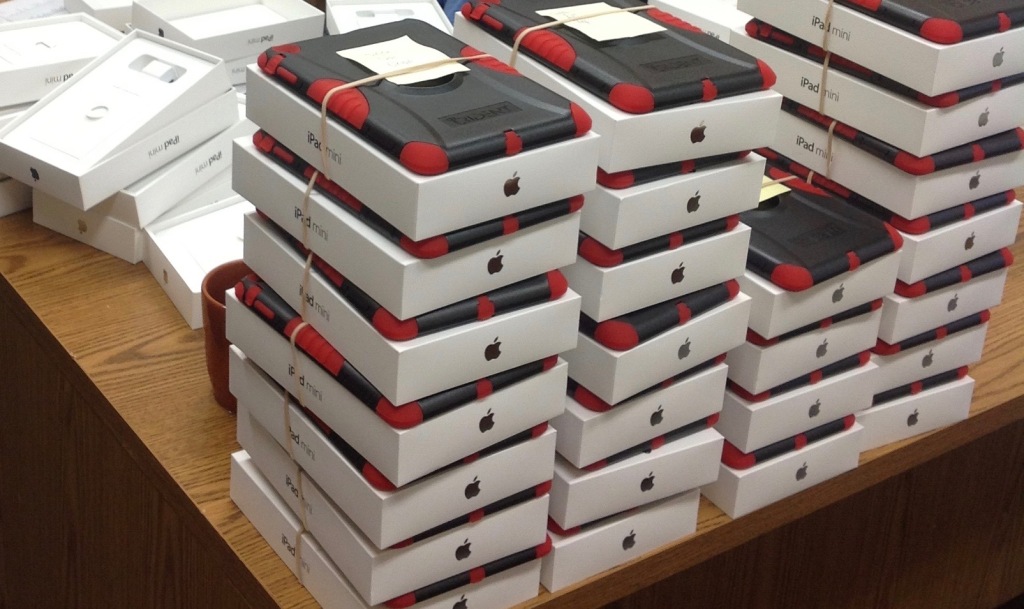
Over time, our school moved from iPads to Chrome Books…sometimes we still use pencils and crayons!

However, I have grown to appreciate (if not enjoy) exercise, and for a while became a bit of a geek when it came to tracking my progress. I even joined in the craze of counting my steps over the period of a day. That being said, I thought it would be interesting to see how many steps I took on one particular day in the early part of the school year. After all, our campus offers five wings of classrooms, a lush grassy courtyard, expansive outlying fields, and a few sets of staircases. Imagine my self-proclaimed pat on the back when on the second day of school, I logged 11,163 steps – and that was just back and forth between the administration building and classrooms. To be fair, we had just implemented our 1:1 iPad program and I kept getting SOS calls for assistance with passwords and Wi-Fi. In between, my curiosity about the deployment kept me popping in and out of classes to make sure all was going as planned. Subconsciously, however, I wonder if on that particular day my underlying non-altruistic goal was to rack up as many steps as possible. All in all, I was pretty impressed and later granted myself the gift of a great excuse to NOT to go to the gym.

Since then, I honestly have lost my step counter (and the interest to count them)! So much for my elaborate explanation to simply say that I can’t stand always being in my office; it is much more exciting to roam the campus. 

Recently, I had the privilege of walking into several interesting scenarios. For example, as I ventured toward Wing 5, I heard what sounded like a live auction. Turns out, it was a live auction! The Economics teacher had given his senior students a stash of bills (Monopoly money) and they were bidding for prime seats in the classroom. Not that any of the seats are that bad, but the bartering was especially heated for the two special posts on the library’s couch.

Speaking of authentic lessons, later that same week, I ran into a group of freshmen winding their way among the trees, breezeways, and sprinklers. Each was holding a baggie filled with either peanuts or grapes or nothing at all. “We are hunters and gatherers,” they responded to my quizzical look.            

“I am going to eat, but the others are going to be hungry,” said one student as she showed off her stash of grapes. (I made a mental note to suggest that the theology teachers write up a lesson plan on the Works of Mercy to address that issue of feeding the hungry!)

I also stopped by the theater where our fine arts teacher led his Music Theory class. It was fascinating to watch the students at the white board noting and denoting musical scores. It was even more interesting to see them working on piano keyboards via their iPads. 

If the rest of the school year promised the energy of the first weeks, I knew we could anticipate a “high impact” subsequent 10 months. There are always thousands and thousands of steps to go!

A New School Year

I begin this new school term about 2,280 miles from the Principal’s office I called home for the past eight years. For the first time in two decades, my personal agenda will not follow the academic calendar; my work will not be completed within a school community. Instead, I find myself without a career title, without a defined role, and without a steady paycheck! Transitions never bring out the best in me, but I am able to reconcile this sacrifice of a predictable and comfortable role in lieu of the sacrament I received 36 years ago when I got married.  

Today, I am at peace with the decision to be with my husband in Washington, D.C. as he embarks on a once-in-a-lifetime opportunity in his own career.  While I will continue to work part-time as an educational consultant and mentor (have wi-fi, will travel!), I am testing the waters of life outside the bubble of “school.” Already, I have figured out how to read the metro map, met a gentleman who sells micro-greens at the farmers market, and re-connected with a dear friend. We live within blocks of the Potomac River, where winding paths beckon me to miles of exploration. And, I found a quirky coffee bar just around the corner from our apartment.

With some of the unstructured time I now have, I am determined to complete this blog which, as I have stated before, will be comprised of a liturgical year of essays and a selection of Principal’s Ponderings I have published in my school newsletter over the years. Once completed, I will have in essence written my second book – this one reflecting my time as a high school principal.

“Hail Mary, full of grace…”

A Leaky Sink & The Feast of the Assumption

Ordinary Time – August

Knowing that this would be one of our first school gatherings of the year, I made sure to wake up early with the intention of arriving at school with plenty of time to be ready to lead the students across the parking lot to the neighboring parish where we would attend the Feast of the Assumption Mass. However, when I reached under my kitchen sink for the dish soap to rinse my breakfast dishes, I found a puddle where puddles are not supposed to be!

As kind as they were, when I called the plumbing company, they gave me a four-hour window of when they would be available. The next call was to school to let the office know I would be late. I made a resolution to be patient and told myself to believe that God tells us to slow down once in a while by making us wait. As the first half hour crept by, I logged into the Internet to answer email. I put a load of clothes in the washing machine. Only then did I realize I would miss Mass. 

I retrieved my iPad, pressed the Pope App, and virtually traveled across the technological “parking lot” to the Piazza della Liberta in Castel Gandolfo, Italy where Pope Francis was celebrating the holy day. Thanks to the amazing clarity of video, I was soon part of the large crowd fanning themselves in the village square as Mass began. Having lived in Italy, I immediately placed myself in the scene as I viewed the shops lining the streets, heard the unique harmony of European police sirens blending with the voices of the choir, and gazed at the ultra-blue sky. Men and women who had borrowed an hour away from work stood alongside groups of religious sisters, young children, housewives, and tourists.

My knowledge of the Italian language is passable, and although I did not comprehend every word, I understood. The beauty of the Mass is that in any language, the rituals are the same. What made this Mass even lovelier was that the Gospel was chanted. I could envision Mary as she spoke those beautiful words: “My soul proclaims the greatness of the Lord; my spirit rejoices in God my Savior for he has looked with favor on his lowly servant.”

I will never tire of listening to the Pope (in any language). He speaks with his heart, and his eyes light up as he proclaims his homilies. He made the crowd laugh when he asked them if they prayed the rosary. “Do you pray the rosary every day?” he asked. “But I’m not sure you do…really?”

He focused his homily on three key concepts: struggle, resurrection, and hope. As I listened, I realized that all of us struggle (be it a leaky faucet, a failed test, or much more serious issues like unemployment, ill health, and loss of loved ones). Yet we know resurrection because we experience it every time we share in the Eucharist. And without hope, Pope Francis said, “…we are not Christian.”

At that moment, my prayer turned toward the new school year, which had already begun a few days earlier with fresh energy. In Catholic schools, our calendar is driven in many ways by the Liturgical cycle. As always though, what begins in Ordinary Time often leads us on the most extraordinary paths. My prayer for this year – for all school years – is that we experience the grace to work through the struggles, live as a resurrected faith community, and strive always to hope. 

Principal’s Ponderings

Broken Lockers

Memories flooded back to me with physical force when one of our students came flying into the office on the first day of school flustered about his “broken” locker. This was the exact same locker that had functioned perfectly the day before when he had come to test it out. Now, a minute before his first class of the year, the locker seemed jammed. He assured the office staff that he had the right combination.

Calmly, our office manager scrutinized the master list and asked the student to recite his combination. Well…he wasn’t the only one to transpose a few numbers that morning! 

Nerves and anxiety sparked by a new school year attacked not only students, but also teachers, staff…and the principal! Just the other day, I nearly set off the school security alarm and had to yell for the facility director’s assistance. I had transposed only one number!

For as long as I can remember, my first days of school have been accompanied by strange dreams that weave experiences past and present in a surreal hodgepodge, stomachaches, restless sleep, and incessant talking (just ask my family)!

I believe that being at least a little nervous is a necessary and even healthy reaction to transitions. I never want to become so complacent that I take for granted that all situations will go perfectly. I believe in preparation, hard work, and perseverance. 

However, I recently discovered a quotation by tennis champion who said that some of the best advice she received about being nervous came from her sister: “She told me the other day that champions don’t get nervous in tight situations. That really helped me a lot. I decided I shouldn’t get nervous and just do the best I can.”

That is great advice. I spent some time during the first several hours of school walking around the breezeways and peering into classrooms. The looks on students’ faces spoke volumes ranging from, “I can’t wait to dig into this class,” to “How did I get myself into this?”

As the first couple of days passed, teachers began visiting me during spare moments. Their eyes also reflected the anticipation they were feeling about the months ahead. The best part was hearing the faculty talk about how they were enjoying getting to know our new scholars while reacquainting themselves with former students. Coaches shared the same excitement as they signed up our energetic athletes for this year’s extracurricular activities.

Already this week, our routines feel a bit more established, sleep seems less pestered by weird dreams, and hunger pangs have replaced unsettled stomachs.

We are ready to become champions.

Summer Interlude & A Final Graduation

Ordinary Time – July

In my heart, I knew this year would mark my last graduation at St. Augustine Catholic High School. Our administrative team and I had waited until the very last moment to make that announcement. It had been my final request that the May commencement be focused on our seniors rather than the fact that their school principal would be retiring. I had already let a few people know that my husband had been offered a chance of a lifetime position that might ultimately stretch our home boundaries across the country to Washington, D.C. While our roots would remain solidly planted in the Arizona desert we call home, I could not stay in a position that I might have to leave over the next few months.

I bargained with God not to let me cry at every juncture of the goodbye process. He didn’t agree to my terms, and I felt like an emotional wreck by the time I drove out of my parking spot for the last time in mid-June.

Now it is July, and the bell will soon sound the beginning of the 2019-2020 school year. For the first time in years, I will not be making the inaugural morning announcements. Already, the school’s website has changed to reflect the new faculty and staff. The handbooks have been updated, class rosters set in place, instructional resources ordered, and school policies refreshed. Even without me, those tasks have been accomplished.

This summer has been one of mixed emotions. For decades, this season has been defined by the end of one school year and the beginning of another with maybe a week or two of vacation squeezed in. As much as I determined that the success of the school was contingent on my being on “alert” 24/7, I am now experiencing what I have always known – no one is truly indispensable. Desperate as that sounds, it is also quite humbling. I may feel like I have lost my direction, but in reality, I am simply forcing myself to take a tentative step onto “my road less traveled.” Who knows what I will discover? It’s scary, but I think it might also be okay. 

My heart is beating an odd cadence as I try to put into words the feeling of being untethered to what has been my community for so long. I have avoided writing for the past few weeks because my thoughts are scattered, and my identity is obscured. This blog – my rough draft of a future book about being a secondary school principal – is out of order. I started it in Lent with the idea that I would chronicle a full academic year in the life of a high school principal. I would post essays throughout the months, rounding them out with articles I have written over the years for my school newsletters. I would do this until I reached Lent again. Then, in the editing process, I could gather all these posts, organize them into a school year, and publish (Still) Extraordinary Time, my second foray into authorship. But now, I find myself writing about retiring at a point when I should be writing about a new school year. I confuse myself.

One truth I have discovered is that it is often better to dive into the unknown rather than think about all the things that can go wrong. This post represents an interlude (and probably the last entry in the book when I finally get to that point!). I will continue to post to this blog the ponderings and essays that I have rightfully written over the years. After all, those experiences I am sharing were mine, are mine…and honestly, capture moments in the lives of so many of us involved in Catholic education – hence the reason I feel compelled to share them. (Really, who cares if this is out of order? I am not even sharing the blog with that many people anyway. And honestly, if I really lose focus, I could simply delete all of this and not concern myself with the order at all! WordPress is my playground.)

Whew! I feel better. I have been wrestling with my deflated muses for weeks.  Now, I have a direction. The next post will bring us into a new school year based on the experiences that many of us in education share. At some point in our lives, we are all first graders, high school students, and graduates. Change is part of the process.

Signing Yearbooks

Ascension and PentecostMay/June

We had one class period to go before graduation. I had already decided that my Advanced Placement students would revolt if I dared to give them a final exam just a day after they had completed the grueling four-hour marathon designed by College Board to test their year-long effort to learn everything there is to know about literature! Not able to bear their glazed countenances and complaints of cramped fingers, I resorted to what all good teachers do at the end of the year – snacks and a movie.

So as Robin Williams stood on his desk before his baffled students and asked them to rip out the preface to their textbooks in The Dead Poets Society, my own scholars munched on M&Ms. Honored to be asked, I spent the next 45 minutes signing their yearbooks.

It may have been the darkened room, the comfortable silence among a community of learners who had become friends, or my tendency toward the sentimental, but I struggled to pen just the right words for each of my students. These simple lines must carry enough weight to invoke memory years from now. My mind drifted to the poignant and powerful muses of my own last years of high school.

I was one of those students who flaunted her independence. I could walk among the put-together popular group and yet peripherally enjoy conversations with the counter-cultural students of the 70s who hung out in the parking lots. My best friends were those I made in my World Literature class, the ones who also were into creative writing, the ones who worked on the yearbook, the ones who hung on every word of our teacher and adviser – the omniscient Mrs. Doerfler. When we began to take ourselves too seriously or not seriously enough, Mrs. Doerfler would simply raise an eyebrow. That wordless look either grounded us or nudged us to shed high school inhibitions and release our collective energies. Mrs. Doerfler was the teacher I aspired to become. 

The yearbook I still keep front and center on one of our bookshelves at home is not my senior annual, but the book from my junior year, the one entitled Legend ’77 from Brookfield Central High School in Brookfield, Wisconsin. The inside pages welcome students into the “Magic Theater,” an allusion to the house of mirrors in Herman Hesse’s novel Steppenwolf. There, a person could go to find his past reflected in a series of images, and then explore the possibilities for change that would affect his present and future.

In 1976-1977, I lived for Yearbook (with a capital “Y”) as a member of the editorial staff. My task was to interact with the narrative that wove its way through the book. The introduction: “This book is a magic theater, a theater of the mysterious, playful, and tender moments, of the possibilities for change in our mutual and separate lives here at school; a magic theater for one year, for whatever value it may hold in our collective memory.”

That’s me (right), extending the metaphor of The Magic Theater, 1977

The end, written by our chief scribe Anne Hughes: “We lived at school and we lived our book. Perhaps most important, we lived our theme. We were and are changes in ourselves, constant metamorphoses, each of us half clown and half genius…we are all of us, and this book is each of us.”

Only when we are in high school are we allowed to be so pithy, so dramatic, so in love with possibility.

It is this possibility that I wish to impart as I sign my name to the messages I write to my students. During the last five minutes of class, I turn off the movie. I ask which of the novels and plays we read that they will “carry with them” when they leave AP Lit. Surprisingly, their responses are diverse. My romantics cite Pride and Prejudice,while those who enjoy the darker gothic side of literature noted Wuthering Heights and Frankenstein.One student mentioned Waiting for Godot,the existential play I saved for the end of the year when I knew students were focused more on questions than answers. 

Interestingly enough, Waiting for Godot, was the play that I most remember from high school. A large photo in Legends ’77 memorializes two of my classmates reading from Samuel Beckett’s script. Even better, the last page of my yearbook includes this tiny excerpt:

Gogo:  We always find something, eh Didi, to give us the impression we exist?

Didi:   Yes yes, we’re magicians. But let us persevere in what we have resolved, before we forget.”                                                                                  

Samuel Beckett, Waiting for Godot

I pray my students will forever remember not only the existence, but the essence of their high school years. I know I will.

Principal’s Ponderings

Graduation

Graduation celebrations have a way of tying all the loose ends of high school together in one very beautiful package. The beauty comes not from the celebration itself, but from the richness of the odyssey. In fact, Homer, the author credited for sharing the epic poetry found in The Iliad and The Odyssey, gives us this philosophical gem: “The journey is the thing.”

That “thing” is the culmination of hard work, of persistence, of failure, and of success. All of this is represented symbolically in the diplomas we frame and hang on our walls. One of our school’s recent graduation speakers noted that although a high school diploma is an important milestone, it really signals another new beginning. With that beginning comes the responsibility to work hard and to live and to love in the best way we can. To this generation of young adults, our speaker admonished that the best advice might be to put down the cell phones and get to work!

Each time we celebrate a graduation, I feel that everyone in attendance experiences a moment of completeness and transition. It is the students who receive final high school transcripts, but their accomplishments have been predicated not only on their individual hard work, but on the determination of others. Parents especially need to know they have had a part in earning the “credits” of their children. Teachers have the benefit of facilitating the learning process – and in the end, understand implicitly that they have imparted knowledge and more importantly, they have gained knowledge. 

Jokingly, I say that during the final weeks of school, the seniors make it easy to say goodbye. But that is not true.

Although they appear to barely keep their heads up as they plod through research papers for history classes, complete lengthy math study guides, and take one more science test, it seems to hit them all at once that high school is over. At that juncture, they also test the waters of rules they have been compelled to follow for the past years – defying the uniform code, “forgetting” to shave in the morning, and ignoring the tardy bells.

However, I can attest – as well as many of our teachers – that the seniors are quite reticent about saying goodbye. And so are we. “This time of year makes me very sentimental,” said one of our school’s math teachers, noting that after spending so much time with his seniors that it is very hard to let them go.

I agree. I remember one of the seniors who came by my office and started chatting about his high school experiences and his goals for the future. We spent more quality time talking in that 15 minutes than we had collectively during the past four years.

Another teacher, who had known and followed nearly a dozen of our seniors since they were in kindergarten, said one of her former students asked her what she would teach when she followed her to college!

Homer’s words hearken back to the 8th century B.C. His philosophies touched off discussions by his successors. Plato, Socrates, Aristotle…all of whom persisted in defining a meaning in life and purpose. We are destined to carry on the pursuit of learning, even in a world complicated by how we go about doing that monumental task. Today, our classes are held in rooms replete with wi-fi and smart boards as opposed to large columned amphitheaters on the hills of Greece. But just like those who came before us and will follow long after, we continue to search for that “thing.” It is time to place another yearbook on the bookshelf.

High Five to the Holy Spirit

Pentecost – May

The best view of cars turning into our Stoney Ridge neighborhood from Dutchman’s Lane was from the second-floor bedroom window of our family’s Easton, Maryland home. Once or twice a year my grandparents would drive from Upstate New York to see us – highly anticipated visits from the perspective of four young children who would garner undivided attention as soon as Grandma and Grandpa would walk in the door. 

We always knew when our grandparents were coming because our mother would turn into a task master as she doled out chores such as dusting baseboards, polishing the refrigerator (really?), and making sure no dust bunnies had settled under our beds. We called it “Grandma’s Eve,” but that just added to the festive mood as we prepared for the moment they would arrive – usually bearing exotic goodies like thick Italian “Tomato Pie,” homemade sesame cookies, small gifts, and pockets full of jelly beans (Grandpa).

On the day of their pending arrival, I would go upstairs and perch at the window. I wanted to be the first to herald their arrival. Often, I would begin my vigil an hour too early, knowing intuitively that my wait might be prolonged, but that I certainly didn’t want to miss them if for some reason my timing was off.  Back then, I looked at prayer like story book characters do when they are granted wishes. I thought that if I prayed hard enough, the next car coming down the street would be my grandfather’s. When that didn’t work, I gravitated toward bargaining mode to the tune of, “God, I know that the third car coming down the street will be my grandparents.” When that didn’t work: “God, the next blue car that comes down the road will be them!” With or without my fervent pleas, my grandparents invariably arrived in the allotted time it would take to drive the long miles along the turnpike from their house to ours. Wrapped in childhood allusions of those moments, I like to think I might have thanked God and given the Holy Spirit a high-five before running down the stairs to greet them as they pulled into the driveway.

As I have gotten older, my prayer life has matured, but there are times I still feel like that little girl standing at the window wishing for the next anticipated moments of life. As the wife of a motivated and mission-driven husband, we have spent more than three decades working toward the next step up the career ladder. As a mother, I went from a laundry room of onesies and diapers to gym shorts and college t-shirts while encouraging my child to walk, then run, and then to become independent. I still catch myself bargaining with God as I pray for the safety and well-being of those I welcome and hold so closely in the “neighborhood” of my heart.

Life is filled with cycles of preparation and anticipation. A high school principal’s goal is to guide students from freshman to senior year through a network of curriculum and social challenges. Educators provide opportunities along the way, and we look for signs to ensure us that we are shepherding our students along the right paths. We document learning through grades, tests, and report cards. 

What can’t be measured though, is what should not be measured – the gifts our students bring to the community as a whole. These exemplify the gifts of that oft-unrecognized Holy Spirit. After all, during this spiritual time of Pentecost, aren’t we all supposed to be reminded of such offerings of the spirt to include wisdom, understanding, knowledge, and fortitude? My own life experiences have led me to a much deeper understanding of what it takes to work, to teach, to wait, to react, to respond, to lead, to conform…and mostly to pray not for signs and wishes to come true, but rather with the knowledge and with a sense of peace that what is to come will come.

Principal’s Ponderings

High-Stakes Tests

“Take this seriously. It’s a high-stakes test,” I admonished the group of juniors who sharpened their pencils and prepared to take the ACT exam.

As I read from the provided script of instructions, I implored the students to notwaste time, to notuse electronics, to nottalk, to notlook around, to notget up, and to notask questions. My own stomach knottedaround all those negative commands! I remembered being in their seats. I recalled the panic I felt about potentially leaving “a stay mark outside a bubble,” and even worse, mixing up the bubbles causing an entire exam to become worthless because I did things out of order. Would life go on if I messed up that badly? At least we could pray. My friends and I had not been able to do that, out loud anyway, in the public schools I attended.

So, what does it mean to say that the ACT or the SAT are high-stakes tests? It means that the results of these tests are used to assist colleges in making important decisions about whether a student is accepted into a school or his or her choice, as well as determining the value of some scholarships for which students typically apply.

I admit that I struggle with the idea of standardized testing. Too many times, the results are reported to represent an entire group rather than individuals. This is somewhat helpful in determining the big picture of curriculum, but I find the results are most valuable for educators when used to track individual progress of students as they move from freshman to senior year. By analyzing a student’s scores, we can track individual growth. Better than that, we can pinpoint specific areas in which students may need intervention or extra practice. 

Because of our past scores, the faculty has been able to focus our professional development on developing strategies to help students dig into complex text. Reading, especially non-fiction text, is important not only in language arts classes, but also in math and science and even the fine arts.

Observations from this past year show that the juniors seemed to approach the test very seriously. They spent more than three and a half hours working through academic sections broken down by reading, language, math and science. Then they dug in for another forty minutes writing an essay.

During their lunch and before they went back to class for the last block of the day, I heard all sorts of comments. Some thought the science was manageable because they were currently taking chemistry; others thought it was difficult because they haven’t practiced chemistry for a year. They all pretty much agreed that the math went from easy to hard without a progression and that the writing was “kind of fun.” 

Post testing, I handed out chocolate kisses to the students whose exams I had proctored. When I was younger, my family would go to Hershey, Pennsylvania to visit the chocolate factory. I still remember conveyor belts filled with thousands of perfectly wrapped, perfectly lined up kisses. Every once in a while, a factory worker would pluck a chocolate off the conveyor belt because it didn’t fall into place correctly, or maybe was missing a wrapper.

With this image, I thought of our students taking a standardized test. For the most part, they fall in line and do what they need to do. The data tells a good story, but my favorite moments of teaching are non-standard. I love it when students question instructions and help me to see what I thought was perfectly clear from a whole different perspective. I enjoy watching them solve problems as collaborative teams and in the process navigate the tricky dynamics of working together. I relish the process that permits students to talk, to appropriately use technology, to move around, to ask questions, and even to waste a little time now and then. This is where learning happens. 

By the way, the chocolate kisses I handed out to the students happened to be wrapped in all different colors and some even tasted like carrot cake (Easter kisses)! A few of the students took the traditional ones, others the less traditional, and still others didn’t take one at all.

The Universal Dance

Easter – April

Blinding me as I sought to find the outer edges of the celestial object, the full moon filled my left eye. I gazed through the coin-sized lens of the telescope. Perception tunneled and reflected by mirrors and technology I don’t quite understand forced me to look at the familiar in an unfamiliar way. Once again, I was reminded of my longing – within a 15-second glance – to understand how my own human orbit fits into the grand scheme of the world.

It was Holy Thursday, and friends visiting from the East coast made plans for us to go to the National Observatory on Kitt Peak, about 55 miles from Tucson and nearly 7,000 feet up into the Quinlan Mountain range. This scientific laboratory has been in operation since 1958 and is operated by the National Optical Astronomy Observatory on land leased from the Tohono O’odham Nation. In addition to those managed by the NAOA, several universities conduct research either on site or remotely through the numerous telescopes housed in vintage domed metallic monuments that punctuate the rocky landscape.

Our tour began at sunset with a vast westward view of the Sonoran Desert. As the final rays descended below the visual horizon, a 180-degree turn allowed our tour group to witness the rising full moon. To feel embraced in the revolution of sun, moon, and emerging stars in the quiet moments of sunset and moonrise…well, I wasn’t the only one who immersed myself in the drama of this natural cinematography.

Once the sky darkened, we charted the stars and grabbed binoculars to look for familiar constellations, marveling at what we cannot normally see, searching back light years to locate elusive stars between the stars. We then took turns at a 20-inch reflector telescope where we first looked at a set of stars that to the naked eye looks like one orb , but on a deeper magnified dive, reveals twins – one yellow and one blue! We glanced at a constellation, totally invisible from the ground that is comprised of several hundred thousand stars. I admit to feeling emotional as I focused on a nebula. Within this gaseous swirl, I saw stardust, dying light.

As I waited my turn to see the moon, I enjoyed the peace of sitting within the confines of the observatory dome, wrapping myself in the breezes drifting through the open roof. Holy Thursday – a night of reckoning. Good Friday, when some say an eclipse darkened the afternoon sky upon Jesus’ death – a divine marriage of God and the cosmos. And then there is “me,” a relatively tiny celestial being, whose faith tells me that my tenuous hold to this spinning Earth is not only reckoned by gravity, but by a force that was created by God. Easter. He has risen with the sun, the moon, and the stars. I am an integral part of this universal dance.

Principal’s Ponderings

Eternal Embrace – A Poem

At your birth you stretch your arms for the first time 
Reach for your Holy Mother from the crib 
You embrace us...all 
 
Later, we encounter you, arms outstretched
Reaching for your Holy Father from the cross 
Eternally embracing us...all 
 
In the chaos of Holy Week, we are swept into that timeless crowd 
Willing and unwilling voyeurs
Soulful, sorrowful, sacrificial
 
Despite the confusion, your labored breath plays soft chords 
Among transparent leaves nestling buds
Spilling color on a fresh season
 
We sense fragile light casting shadows around corners of day 
We chase hope through a lifetime 
Three days made all the difference 
 
A profound timeline persists
While the sun sets and rises on your crucifixion 
Nature continues to weave star-filled patterns of the hours 
 
We dare to cast our eyes into the empty tomb 
Reaching through Heaven’s light
All…seek your embrace